


Transitioning your dog from crate to free roaming can be challenging. This guide provides proven steps to ensure a safe and smooth process, helping you and your pup achieve peace of mind.
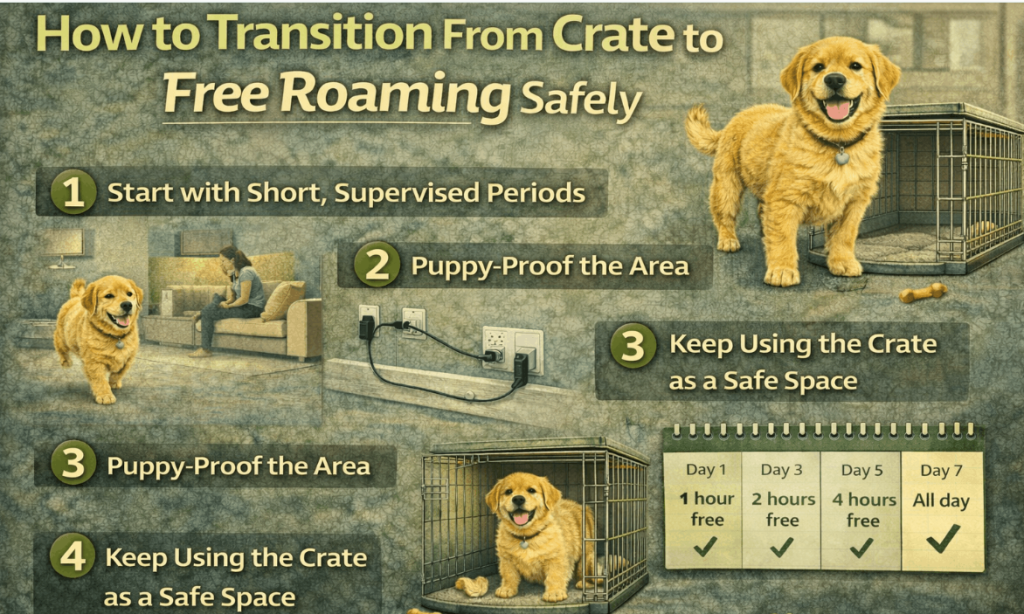
How to Transition From Crate to Free Roaming Safely
Ever wondered why your pup seems perfectly content in their crate but turns into a tornado of destruction when left to roam free? You’re not alone. Transitioning from crate to free roaming is one of those milestones that can make or break your peace of mind—and your furniture.
Here’s the deal: Transitioning from crate to free roaming safely takes patience, preparation, and a solid understanding of your dog’s behavior. It’s not about flipping a switch one day and declaring, “You’re free!” It’s a gradual process that builds trust and responsibility.
Let me walk you through exactly how to do this right.
If you’re new to crate training, begin with our step-by-step guide that explains the safest, no-cry method from start to finish.
👉 Crate Training a Puppy: Complete Guide, Tips & Schedules
Quick Facts: Crate to Free Roaming Transition
| Quick Facts | |
|---|---|
| Best Age to Start | 6-12 months (varies by breed) |
| Time Required | 4-8 weeks (gradual process) |
| Success Rate | 85% with consistent training |
| Key Tools | Baby gates, cameras, high-value treats |
| Common Mistakes | Moving too fast, skipping supervision |
| Critical Skill | Mastering “leave it” and “place” commands |
The Step-by-Step Transition Plan
⏱️ Time Required: 4-8 weeks
📋 What You’ll Need: Baby gates, pet camera, high-value treats, patience
Step 1: Master Crate Independence First
Before even thinking about free roaming, your dog needs to be completely comfortable being alone in their crate. I’m talking:
- No whining or barking when you leave the room
- Willingly entering the crate on command
- Settling down quickly (within 5-10 minutes)
- Staying calm for at least 2-3 hours
Pro tip: If your dog still gets anxious when crated, you’re not ready for this transition. Go back to crate training basics.
Step 2: Start With Supervised Freedom
Begin by giving your dog freedom in one small, puppy-proofed area while you’re home and actively supervising.
How to do it:
- Use baby gates to block off a section of your living room or kitchen
- Remove all temptations (shoes, cords, trash cans)
- Stay in the same room but ignore your dog (read a book, work on laptop)
- If they start chewing something inappropriate, calmly redirect to a toy
- After 15-20 minutes of good behavior, reward with praise and treats
Real talk: This is where most people fail. They think “supervised” means watching TV while occasionally glancing at their dog. Nope. You need to be actively observing.
Step 3: Gradually Increase Time and Space
Once your dog can handle 20-30 minutes of supervised freedom without incidents, start:
- Increasing time: Add 5-10 minutes per session
- Expanding space: Move the baby gate to include more area
- Adding distractions: Leave a toy with treats, have someone walk by
Sample progression:
- Week 1: 20 minutes in kitchen
- Week 2: 30 minutes in kitchen + hallway
- Week 3: 45 minutes in living room
- Week 4: 60 minutes with access to two rooms
Step 4: Test Short Absences
Now comes the real test—leaving your dog alone in the expanded space.
How to do it safely:
- Start with just 5 minutes (yes, really—set a timer)
- Use a pet camera to monitor behavior
- Return before any anxiety builds
- Gradually increase absence time by 5-minute increments
What I’ve seen work best: The 5-minute rule. Most dogs can handle 5 minutes alone without issues. It’s the 6th minute where problems often start.
Step 5: Full House Access
Only after your dog has successfully handled:
- 60+ minutes of supervised freedom
- 30+ minutes of unsupervised time in expanded space
- Multiple short absences without incidents
…can you consider full house access.
Critical safety measures:
- Keep bedroom doors closed (prevents hiding/destruction)
- Use baby gates to block staircases
- Keep trash cans secured
- Remove or secure anything valuable
Common Mistakes That Derail Progress
Moving Too Fast
I can’t tell you how many times I’ve seen owners go from crate to full house access in a week, then wonder why their couch is shredded.
The fix: Stick to the timeline. If your dog regresses, go back a step.
Skipping Supervision
“Oh, he’s fine when I’m home!” Famous last words before coming home to a destroyed house.
The fix: Supervised sessions are non-negotiable. You need to see how your dog behaves when you’re present but not interacting.
Ignoring Warning Signs
Pacing, whining, excessive drooling—these aren’t just “quirk” behaviors. They’re stress signals.
The fix: If you see these, your dog isn’t ready for more freedom. Back up and reinforce calm behavior.
When to Consider Professional Help
If after 8 weeks of consistent training your dog still:
- Shows severe anxiety when left alone
- Destroys items despite supervision
- Can’t settle without constant attention
It might be time to consult a professional trainer or veterinary behaviorist.
FAQ: Your Crate to Free Roaming Questions Answered
How long does the crate to free roaming transition take?
Most dogs complete the transition in 4-8 weeks with consistent daily training. However, some breeds (especially high-energy working dogs) may take 10-12 weeks. The key is watching your dog’s behavior, not the calendar.
What age should I start transitioning?
The ideal window is between 6-12 months old, when dogs have developed better impulse control but haven’t yet formed ingrained destructive habits. Puppies under 6 months typically lack the bladder control and self-regulation needed.
Can I skip the baby gates?
While you technically can, I wouldn’t recommend it. Baby gates serve two critical purposes: they limit access to prevent accidents, and they help your dog learn boundaries gradually. Without them, you’re essentially throwing your dog into the deep end.
How do I know if my dog is ready?
Look for these signs:
- Can settle quietly in crate for 3+ hours
- Doesn’t immediately rush to chew things when given freedom
- Comes when called even with distractions
- Shows calm behavior during supervised sessions
What if my dog regresses?
Regression is normal! If your dog starts having accidents or destructive behavior:
- Go back to the previous successful step
- Reinforce basic commands
- Reduce freedom temporarily
- Rebuild trust gradually
Should I use a pet camera?
Absolutely. A pet camera lets you:
- Monitor behavior when you’re not home
- Identify triggers for destructive behavior
- Catch early signs of anxiety
- Reward good behavior remotely (some cameras have treat dispensers)
How much exercise does my dog need before free roaming?
Aim for 30-60 minutes of vigorous exercise before any freedom sessions. A tired dog is a well-behaved dog. For high-energy breeds, consider 90 minutes of exercise spread throughout the day.
What’s the biggest mistake owners make?
Assuming their dog is “cured” after a few good days. Consistency is everything. One successful week doesn’t mean your dog is ready for unlimited freedom. Build the habit over months, not days.
Can older dogs learn free roaming?
Yes! While puppies adapt faster, older dogs can absolutely learn. The process might take slightly longer (8-12 weeks), but the same principles apply. Older dogs often have better impulse control, which can actually make training easier.
How do I handle separation anxiety?
If your dog shows signs of separation anxiety (excessive barking, destructive behavior, potty accidents when left alone):
- Consult your veterinarian to rule out medical issues
- Consider anti-anxiety supplements or medications
- Work with a certified separation anxiety trainer
- Use gradual desensitization techniques
📚 Related Articles
- Puppy health checklist
- Must know – Safe Puppy Buying Guide
- 🛡️ Avoid Puppy Scams When Buying Online
Final Thoughts
Transitioning from crate to free roaming isn’t just about giving your dog more space—it’s about building trust, reinforcing good habits, and setting both of you up for success.
Remember: Every dog learns at their own pace. What takes one dog 4 weeks might take another 12. That’s okay. The goal isn’t speed—it’s creating a safe, happy environment where your dog can thrive.
When you’re ready to take the next step in your dog’s training journey, explore our complete training guides for more expert advice.
Here’s to a home where both you and your pup can relax—without worrying about what might get chewed next!